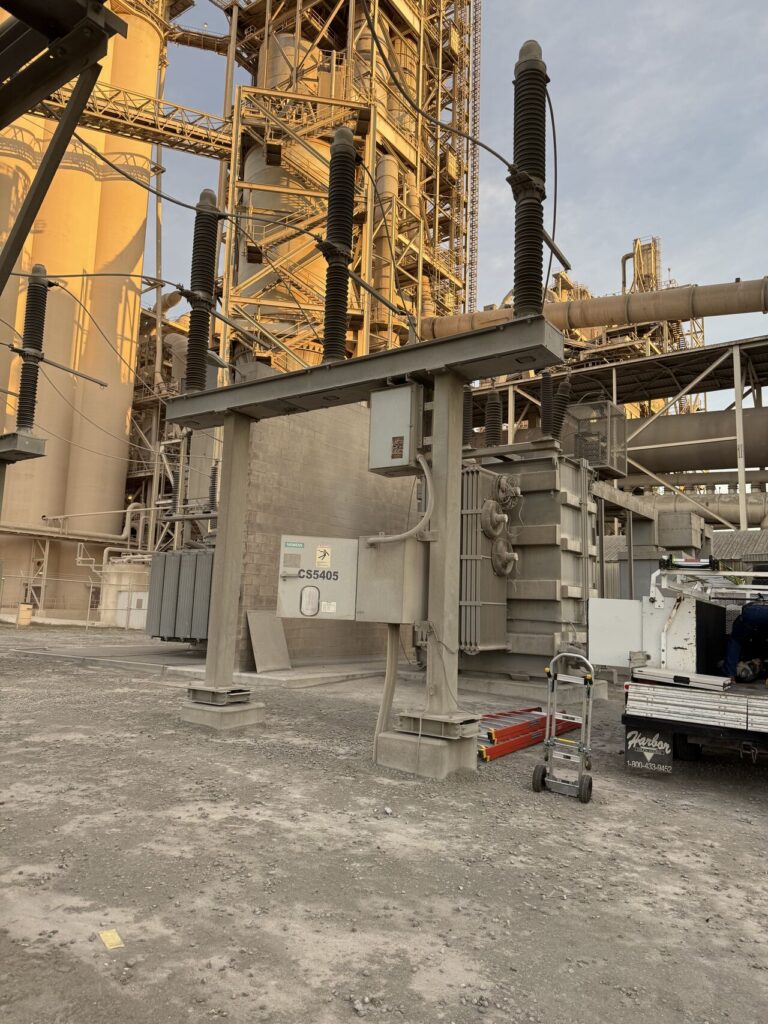
Partial discharge testing detects the small, localized electrical discharges inside degrading insulation before it fails outright. Technicians measure these discharges with four sensor families: transient earth voltage (TEV) sensors mounted on metal-clad switchgear, ultra high frequency (UHF) antennas that capture electromagnetic emissions between 300 MHz and 3 GHz, high frequency current transformers (HFCTs) clamped on ground conductors, and acoustic sensors that pick up the ultrasonic signature of discharge activity. Testing can be performed online with equipment energized or offline under controlled excitation per IEC 60270, which quantifies discharge intensity in picocoulombs. Common practice is an online survey of critical switchgear at least annually and offline testing every 3 to 5 years. With insulation breakdown among the leading causes of switchgear failure, and replacement transformers now quoted at lead times up to roughly four years, partial discharge testing has become one of the highest-value diagnostics a substation owner can schedule.
What Partial Discharge Is and Why It Precedes Failure
A partial discharge is a localized dielectric breakdown that bridges only part of the insulation between two conductors. It starts at a weak point: a gas-filled void cast into epoxy, delamination in a bushing, moisture ingress at a cable termination, contamination on an insulator surface, or a sharp edge that concentrates electrical stress and produces corona. Each individual discharge is tiny, but every pulse erodes and carbonizes a little more insulation. The defect grows, discharge activity intensifies, and the process ends in flashover or complete insulation failure.
That progression is exactly what makes partial discharge so valuable as a diagnostic. Insulation breakdown is widely cited as a leading cause of switchgear failure, and unplanned outages carry costs that can run well into six figures per hour for the facilities they serve. Unlike most failure modes, partial discharge is measurable months or even years before the fault clears itself the hard way. Insulation problems that announce themselves early through discharge activity are among the most preventable failures in a substation.
The Four Field Methods for Detecting Partial Discharge
No single sensor sees every defect, so field surveys typically combine two or more of the following methods:
- TEV (transient earth voltage): capacitive sensors placed on the outside of metal-clad switchgear detect the fast voltage pulses that internal discharge activity couples onto the enclosure surface. TEV surveys are non-invasive, run on energized equipment, and cover a lineup of switchgear quickly.
- UHF (ultra high frequency): antennas tuned to the 300 MHz to 3 GHz range capture the electromagnetic waves each discharge emits. UHF sensing offers strong immunity to external electrical noise and a high signal-to-noise ratio, which is why it dominates gas-insulated switchgear (GIS) monitoring.
- HFCT (high frequency current transformer): split-core clamps installed around ground and cable earth conductors measure discharge pulses in roughly the 3 MHz to 30 MHz band. HFCTs are the workhorse for cable circuits, transformers, and rotating machines because they install without an outage.
- Acoustic and ultrasonic: piezoelectric contact probes and airborne ultrasonic microphones detect the high-frequency sound each discharge produces. Acoustic methods excel at physically locating a discharge site and at catching surface tracking and corona that electrical sensors can miss.
Modern online sensors are compact enough that many can be mounted on energized equipment without an outage. Partial discharge surveys also pair naturally with infrared thermography: thermography finds resistive heating at connections, while partial discharge testing finds insulation defects that generate little or no heat until failure is close.
Online Surveys vs. Offline Testing: What IEC 60270, IEEE C57.113, and NETA MTS-2023 Say
IEC 60270 is the foundational standard for electrical partial discharge measurement. It defines the coupling-capacitor test circuit, calibration procedure, and the core metric, apparent charge, expressed in picocoulombs (pC). IEC 60270 measurements are the language of factory acceptance testing for switchgear, cables, and transformers, and of offline field tests performed under controlled excitation.
For liquid-filled power transformers and shunt reactors, IEEE C57.113-2023 (published March 2024) is the current recommended practice. It covers wideband measurement of apparent charge on transformers excited by AC test voltages between 40 Hz and 400 Hz, with measuring circuits and calibrators specified in compliance with IEC 60270.
On the maintenance side, ANSI/NETA MTS-2023 added online partial discharge survey steps for energized switchgear, switchboards, and panelboard assemblies, formally recognizing that owners can screen for insulation defects without taking an outage. Common industry practice is an online survey of critical assets at least annually, offline IEC 60270-style testing every 3 to 5 years, and permanently installed continuous monitoring on the most critical or least replaceable equipment. Our founder spent years developing electric standards and work methods at PG&E before starting Substation Solutions, and that standards-first mindset shapes how we approach acoustic partial discharge surveys with our FLIR Si-Series acoustic imaging camera: document the baseline and trend against it.
Why the 2026 Equipment Supply Crunch Makes Early Detection More Valuable
The economics of catching insulation defects early have changed dramatically. Since 2019, demand for generator step-up transformers has grown 274 percent and demand for substation power transformers is up 116 percent, driven by data center construction, electrification, and grid modernization. Lead times for high-capacity power transformers now stretch as long as four years, and industry trackers report that of roughly 16 GW of US data center capacity scheduled to come online in 2026, only about 5 GW is actually under construction, in part because electrical equipment procurement has become a critical-path risk.
For a substation owner, the implication is simple: the transformer or switchgear lineup you operate today may be effectively irreplaceable on any reasonable timeline. A failure that once meant a 12-month replacement project now means multi-year exposure, extended outages, and emergency premiums. Partial discharge testing protects exactly those assets, and when a defect is found early, options like circuit breaker repair and refurbishment, bushing replacement, or cable termination rework restore the asset for a fraction of replacement cost and lead time.
Action Steps: Building Partial Discharge Testing into Your Maintenance Program
- Establish a baseline. Run an online partial discharge survey across switchgear lineups, cable terminations, and transformers so future readings have a reference point.
- Rank assets by criticality and replaceability. A 500 kV transformer with a four-year lead time deserves tighter surveillance than a distribution breaker with a shelf spare.
- Set a cadence. Annual online surveys for critical assets, offline IEC 60270 testing at 3 to 5 year intervals, and continuous monitoring where an unplanned failure is intolerable.
- Trend, do not just threshold. A single reading rarely condemns equipment; rising discharge magnitude and pulse rate across surveys is the actionable signal.
- Integrate with other condition data. Pair discharge results with thermography findings, dissolved gas analysis, and circuit breaker maintenance intervals inside a condition-based maintenance program, alongside a coherent approach to transformer testing and monitoring.
- Act on findings while they are cheap. Early-stage defects are repair projects; late-stage defects are outage events.
Frequently Asked Questions About Partial Discharge Testing
What is partial discharge testing?
Partial discharge testing measures the small internal discharges that occur in weakened electrical insulation. Using TEV, UHF, HFCT, or acoustic sensors, technicians detect, quantify, and locate discharge activity so insulation defects can be repaired before they cause equipment failure.
Can partial discharge testing be done while equipment is energized?
Yes. TEV, UHF, HFCT, and acoustic sensors are all designed to work on energized equipment, and ANSI/NETA MTS-2023 formally added online partial discharge survey steps for energized switchgear. Because discharge activity depends on the voltage and thermal conditions the insulation actually sees, online surveys observe the equipment in its true in-service stressed state.
How often should partial discharge testing be performed?
Common practice is an online survey of critical assets at least annually, offline testing per IEC 60270 every 3 to 5 years, and permanently installed continuous monitoring on the most critical or hardest-to-replace equipment such as GIS and large power transformers.
What is an acceptable partial discharge level?
There is no single universal limit. Offline results are measured in picocoulombs of apparent charge against acceptance criteria from the manufacturer and the governing standard, while online survey results are interpreted against baseline readings and trends. A stable low reading is generally benign; a rising trend is the signal that demands investigation.
Which substation equipment benefits most from partial discharge testing?
Metal-clad and gas-insulated switchgear, medium and high voltage cable terminations and joints, power transformers and bushings, and rotating machinery. Any insulation system operating at roughly 4 kV and above can exhibit measurable discharge activity, and the value rises with voltage class, asset criticality, and replacement lead time.
Find Insulation Problems Before They Find You
Substation Solutions performs field diagnostics and condition assessments on substation equipment from 12 kV through 500 kV nationwide, backed by 18+ years of hands-on high voltage experience. If you want help establishing an acoustic partial discharge baseline, interpreting survey results, or building a testing cadence that matches your asset risk, our high voltage consulting team can build the program with you. Schedule a consultation and we will help you decide which assets to survey first.