Substation Services in Amador County, California
Amador County is Mokelumne River country: a chain of hydroelectric powerhouses stepping down the canyon from Salt Springs at 3,700 feet to Electra at 715, above foothill towns where July highs average in the mid-90s. Jackson is about 70 miles from our Woodland shop, roughly an hour and a half or more, and we service equipment across the county from 12 kV through 500 kV.
- ~70 miles
- Woodland shop to Jackson, approx.
- 4 powerhouses
- Mokelumne River Project
- 3,700 ft
- Salt Springs powerhouse
- 12–500 kV
- Distribution to transmission
Who owns high-voltage equipment in Amador County
Amador's high-voltage equipment is concentrated in the Mokelumne canyon, with an investor-owned utility on the 60 kV network, a small public utility district reaching up to Kirkwood, and two municipal water dams on the county's southern edge.
Mokelumne River Project
PG&E's Mokelumne River Project (FERC P-137) runs four powerhouses: Salt Springs at 43.5 MW, Tiger Creek at 54.4 MW, West Point at 14.1 MW and Electra at 105.3 MW. Each ties out on its own line, at 115 kV from Salt Springs, 60 kV from West Point and 230 kV from Electra, under a license that runs to 2031.
Martell substation
PG&E serves the county's retail load and owns its transmission. The Martell substation is the Amador end of the roughly 28-mile Gold Hill No. 1 60 kV line, part of the 60 kV system that links El Dorado and Amador counties.
Kirkwood Meadows PUD
The Kirkwood Meadows Public Utility District, serving the Kirkwood area across the Alpine, Amador and El Dorado county lines, connected in 2014 to a utility substation at Salt Springs Reservoir through about 27 miles of mostly underground line, and keeps a 5 MW backup powerhouse of eight generators.
Pardee and Camanche
The East Bay Municipal Utility District's Pardee and Camanche dams, on the Mokelumne at the county's southern edge, carry powerhouses of 27.8 MW and 11.25 MW.
Mule Creek State Prison
The state prison on Highway 104 in Ione is a large institutional load in the western county, of the kind that depends on its own switchgear and backup power.
Ione clay and silica
Kaolin clay and silica sand mining around Ione brings heavy industrial load to the western county, with the motors, drives and switchgear that go with processing plants.
What the Mokelumne canyon does to substation equipment
Amador's equipment lives in steep canyon terrain, in some of California's most fire-exposed country, and across a thousand-meter elevation spread between its powerhouses. Each of those shapes how it fails.
-
Canyon access and single roads
Water for the powerhouses runs about 25 miles through the Tiger Creek conduit and the Electra tunnel, bypassing the North Fork canyon, and the sites themselves sit at the end of narrow roads. During the 2022 Electra Fire about a hundred people sheltered inside the Electra powerhouse because the road out was cut. For maintenance, that means mobilization time dominates, spares and test equipment have to travel with the crew, and emergency plans need a second way in or a reason not to need one.
-
Fire history and shutoffs
The Butte Fire of 2015 started in Amador County when a tree contacted an overhead line, and the 2004 Power Fire, about 17,005 acres, started during line-clearance work. All unincorporated land in the county falls within moderate, high or very high fire hazard severity zones, and a single shutoff event in December 2020 was forecast to affect 9,573 customers here. Shutoffs add switching cycles, fires contaminate and heat-damage equipment, and both belong in the maintenance record.
-
Heat low, snow high
The powerhouse at Electra, at 715 feet, averaged July highs near 97°F and about 28 days a year at or above 100°F over its long-term record, while Salt Springs, at 3,700 feet, averaged around 85 inches of snow and falls under CPUC General Order 95 heavy loading. The same project therefore needs summer thermal checks at the bottom of the canyon and winter readiness at the top: transformer and connection thermography at Electra, cold-weather SF6 and battery checks at Salt Springs.
What we perform in Amador County
The scope we deliver, framed to Amador's asset mix: a chain of hydro switchyards down one canyon, a 60 kV distribution network in fire country, and institutional and industrial loads in the western foothills.
-
SF6 Leak Detection & Repair
Leak detection and repair on gas-insulated breakers at canyon switchyards from the snow line to the foothills, with leak rates and verified repairs documented for CARB records.
-
Circuit Breaker Repair & Refurbishment
Remanufacture to factory specification, 12 kV through 500 kV, planned around the long mobilization to canyon sites so that parts, tooling and test equipment arrive together.
-
Preventive Maintenance & Diagnostics
Summer thermography at low-elevation powerhouses, winter readiness at high-elevation yards, acoustic partial discharge surveys, and DC battery testing for sites at the end of a single road.
-
High Voltage Consulting
Post-fire condition assessment, commissioning and relay testing, and lifecycle planning for hydro switchyard equipment where replacement means a long lead time and a hard delivery.
-
Methane Leak Detection
Optical gas imaging tuned for methane at industrial and institutional sites in the western foothills where gas equipment sits alongside the switchgear, reported with leak locations and severity.
Acoustic Imaging for Partial Discharge
Partial discharge is the failure mode that gives the least warning. A discharge emits ultrasound, above the range of human hearing, so it is usually inaudible from the ground, and by the time an insulator flashes over the outage has already happened. Infrared shows the heat a discharge eventually produces; it does not show the discharge itself.
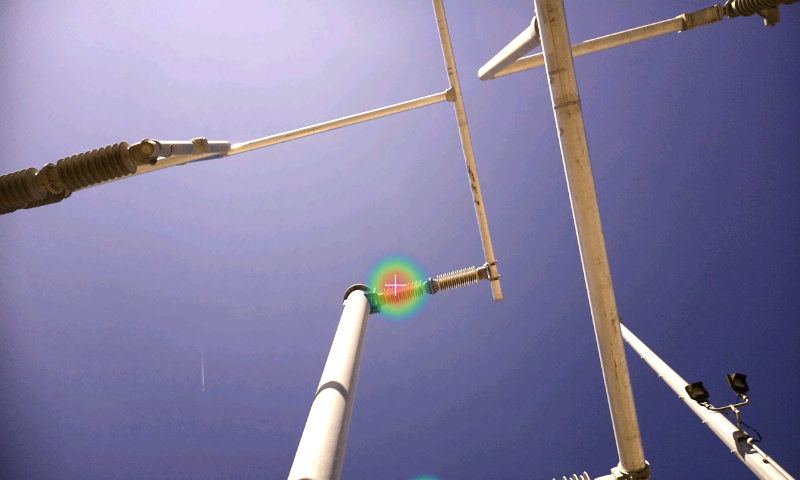
We run a FLIR Si-Series acoustic imaging camera with partial discharge classification. Its microphone array locates the ultrasonic source and overlays it on a live camera image from a safe standoff distance. The camera then classifies the discharge as negative corona, positive and negative corona, floating discharge, or surface or internal discharge, rates its severity from low to very high, and gives a recommended action. That distinction matters, because corona on a fitting and surface discharge across a contaminated insulator are different problems with different repairs.
In one survey of a 230 kV overhead line, the camera resolved discharge on a glass standoff insulator at 46.9 dB from five meters, classified it as surface or internal discharge, and rated it very high severity: strong enough that it might rapidly escalate to complete insulation breakdown. The standoff was also showing high thermal stress. The recommendation was immediate action: visual inspection, cleaning of the polluted surfaces, then repair or replacement of the component.
The regulatory picture for California operators
California asset owners carry obligations that operators in other states do not. We build the documentation into the job rather than producing it afterward.
CARB gas-insulated equipment rule
The California Air Resources Board's regulation on gas-insulated equipment, adopted in 2021 and in effect since 2022, phases out acquisition of new SF6 equipment by voltage class and short-circuit rating on dates running from 2025 to 2033. It pairs that with an annual CO2e emission limit, inventory and gas-handling records, and a yearly report due June 1. Existing equipment can stay in service, which puts leak rate and verified repairs at the center of the compliance record.
EPA greenhouse gas reporting
Under Subpart DD of the EPA Greenhouse Gas Reporting Program, owners of electrical transmission and distribution equipment report SF6 once estimated emissions reach 25,000 metric tons CO2e, the basis in force since reporting year 2025. EPA proposed removing Subpart DD in September 2025 but has not finalized that change, so the obligation stands; confirm the current status before relying on it either way.
NFPA 70B
NFPA 70B became a mandatory maintenance standard with its 2023 edition, calling for infrared inspection at least every twelve months, and every six months for equipment in the poorest physical condition. The 2026 edition, now current, also recognizes permanently installed continuous temperature monitoring. Thermography is on a fixed schedule rather than a discretionary one.
ANSI/NETA MTS-2023
The current maintenance testing specification, approved in March 2023, underpins the test intervals and acceptance criteria we work to. Its Chapter 7 sets out inspection and test procedures for substation equipment, circuit breakers among it, and our thermographic grading follows the NETA Table 100.18 temperature-difference thresholds.
Amador County FAQ
Don’t see your question? Call (833) 723-2723 and talk to a technician.
How far is Amador County from your Woodland shop?
Jackson, the county seat, is about 70 miles from our Woodland shop, roughly an hour and a half or more, and Ione is somewhat closer. Canyon powerhouse sites add time on narrow roads, and upper sites along Highway 88 depend on winter conditions. These are approximate, and response for a given site is confirmed with the quote.
How do you plan work at remote canyon switchyards?
Around the access. Scope, spares, test equipment and outage windows are settled before mobilizing, because a missing part at the bottom of a canyon costs a day. Where a site has a single road in, emergency response plans are worked out in advance rather than during an event.
What does fire-hazard zoning mean for substation maintenance here?
It raises the stakes on equipment condition near energized lines and adds switching cycles from shutoff events. Clearance and vegetation conditions, hardware condition, breaker operation counts and post-event contamination checks all become part of a documented maintenance record.
Why does the same hydro project need both summer and winter checks?
Because its powerhouses span roughly 3,000 feet of elevation. The lowest sits in foothill heat that ages transformers and exposes loose connections, while the highest sees snow, ice loading and cold that expose marginal SF6 seals and weak batteries. One annual visit at one season would miss half of that.
Can you work on equipment for public utility districts and state facilities?
Yes. We work for whoever owns the asset, whether a utility, a public district, a state institution or a private operator, from 12 kV through 500 kV, with documentation suited to public-sector procurement.
Down the Mokelumne and Into the Foothills
Whether it is a canyon powerhouse switchyard, a 60 kV distribution substation or an institutional load's switchgear, tell us what you have and we will tell you what it needs.