
Transformer Testing and Oil Analysis
The power transformer is usually the most expensive and slowest-to-replace equipment in a substation, with replacement lead times that can run to years. We test and assess transformers, and track their condition with dissolved gas analysis and thermal monitoring, so owners see a problem trending in time to plan the response.
- 12–36 months
- Typical routine test cycle
- Annual
- Typical DGA sampling
- DGA + thermal
- Online monitoring
- 12–500 kV
- Distribution to transmission
Chemistry, Electrical Tests and Monitoring
A sound transformer program combines three kinds of evidence. Our field guides go deeper on each.
Dissolved gas analysis
DGA quantifies the fault gases dissolved in the oil (hydrogen, methane, ethane, ethylene, acetylene, carbon monoxide and carbon dioxide) and is interpreted under IEEE C57.104-2019. Often called the blood test for a transformer.
Oil quality screen
A standard oil program pairs DGA with dielectric breakdown voltage, moisture content, acid number, interfacial tension, color and power factor, with furan analysis added when paper condition is in question.
Electrical tests
Offline tests such as power factor, sweep frequency response analysis and winding resistance characterize insulation and mechanical condition, establish a baseline for new units and confirm what a changing trend means.
Online monitoring
Permanently installed sensors track dissolved gases, moisture-in-oil and top-oil and winding temperature continuously, so a sudden change is caught between scheduled tests.
A Snapshot and a Heartbeat
Testing and monitoring answer different questions. Testing is a periodic, in-depth snapshot that establishes a baseline, investigates a suspected issue or validates insulation after a grid event. Monitoring is a continuous, online heartbeat that tracks trends in dissolved gases and temperature while the unit carries load.
Owners who rely only on testing can miss a fault that develops between visits; owners who rely only on monitoring may see stress without the diagnostics to confirm what is wrong. The practical answer is to baseline every unit, then monitor the critical ones.
- Pre-commissioning tests set the baseline
- Routine testing tracks aging, typically every 12 to 36 months
- Post-event testing verifies integrity after faults or surges
- Online DGA and thermal monitoring on critical units
From Baseline to Repair-or-Replace Decisions
-
Establish a baseline
Pre-commissioning or first-visit testing captures where each unit starts, so later results are read as a trend rather than a single number.
-
Set the interval by consequence
Most utility transformers are sampled for oil analysis annually, with critical and large units sampled semiannually or quarterly, and routine electrical testing typically runs every 12 to 36 months depending on load and environment.
-
Monitor what matters most
Critical, heavily loaded or aging units earn online DGA and thermal monitoring, so a sudden increase is caught before the next scheduled test.
-
Act on the trend
A trend line tells you almost everything. When results move, lifecycle planning turns condition data into a repair, refurbish or replace decision made on your schedule.
Transformer Testing FAQ
Don’t see your question? Call (833) 723-2723 and talk to a technician.
When is transformer testing required?
At three points: pre-commissioning, to establish a performance baseline; routine maintenance, to track aging, typically every 12 to 36 months depending on load and environment; and after an event such as a fault or surge, to verify integrity before the unit carries load again.
What is dissolved gas analysis?
DGA measures the fault gases dissolved in a transformer’s oil, including hydrogen, methane, ethane, ethylene, acetylene, carbon monoxide and carbon dioxide. Which gases appear, and how fast they rise, points to overheating, partial discharge or arcing inside the unit. Results are interpreted under IEEE C57.104-2019.
How often should transformer oil be tested?
Most utility transformers are sampled annually, critical and large units semiannually or quarterly, and any unit showing abnormal gassing on an accelerated schedule until the trend resolves.
What is the difference between transformer testing and monitoring?
Frequency and depth. Testing is a periodic, in-depth snapshot of condition; monitoring is continuous, online tracking of dissolved gases and temperature. Testing confirms what is wrong; monitoring catches change between tests. Most programs need both.
Do you offer online transformer monitoring?
Yes. We provide dissolved gas analysis and thermal monitoring systems that track transformer health in real time, alongside periodic testing and condition assessment.
Transformer Testing Articles
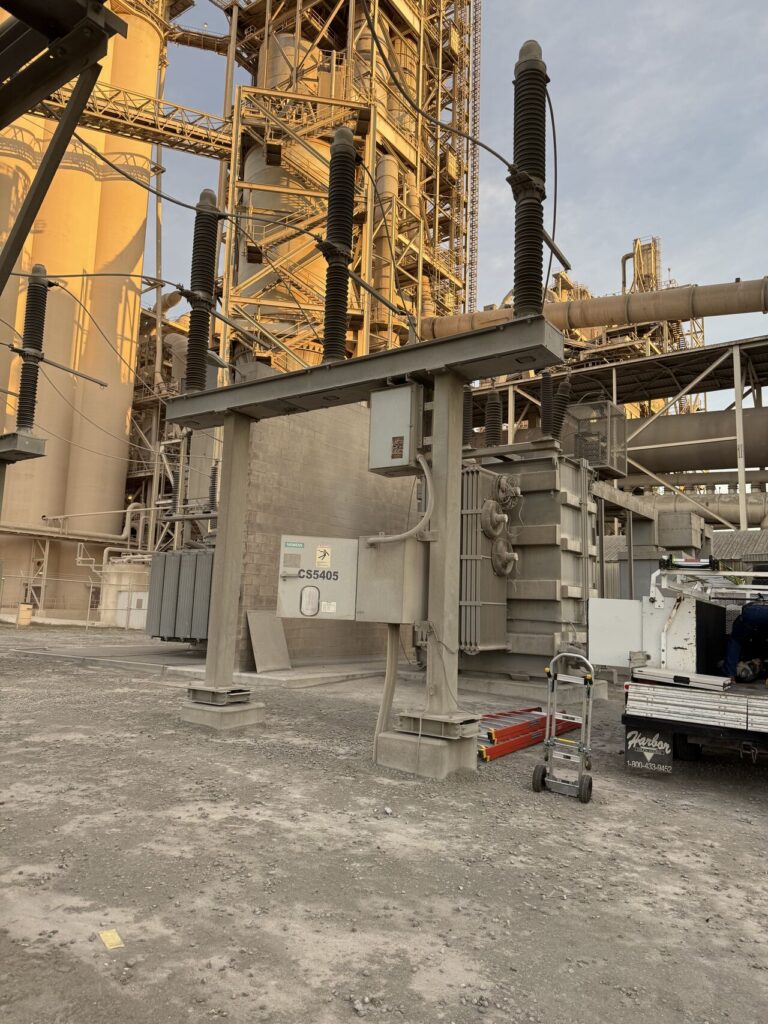
Transformer Power Factor Testing: What Doble Test Results Actually Tell You
What transformer power factor (Doble) test results actually tell you: what the test measures, limits and temperature correction, bushings, and when to act.

Transformer Oil Testing: What Each Test Tells You and How Often to Run It
Transformer oil testing explained: what DGA, dielectric breakdown, moisture, acid number, interfacial tension, and furan analysis each reveal, how often to sample under NETA MTS-2023, and…
Partial Discharge Testing in Substations: Methods, Standards, and When to Schedule It
How partial discharge testing works: TEV, UHF, HFCT, and acoustic methods, plus when to test.
Get a Straight Read on Your Transformers
Whether you need a baseline on new units, a routine test cycle, online monitoring on critical transformers, or a second opinion on results you cannot reconcile, tell us what you have and we will tell you what it needs.