
Substation Services Across Northern California
We work from a shop in Woodland, on the western edge of the Sacramento Valley. From there the valley floor and the Sierra foothills above it are day-trip country: eight counties where we know the utilities, the switchyards and what the local weather does to insulation. That proximity is the point of these pages. The nationwide practice behind them has not changed.
- Two bases
- Woodland CA and Conner MT
- ~50k
- Field miles a year
- 24-hour
- Mobilization, continental US
- 12–500 kV
- Distribution to transmission
What the grid looks like between Woodland and the Sierra crest
This corner of California has an unusual concentration of grid institutions inside a short drive, and an unusually mixed pattern of who actually owns the high-voltage equipment. Both facts change how a job gets scheduled, switched and documented.
California ISO
The state's grid operator is headquartered in Folsom, inside the region these pages cover. Transmission-class outage windows across most of California are coordinated from here.
Balancing Authority of Northern California
BANC is operated by SMUD and covers a footprint well beyond Sacramento County, taking in municipal and irrigation-district load across the valley. It is a separate balancing authority from CAISO, which matters for scheduling.
Western Area Power Administration
WAPA's Sierra Nevada region is headquartered in Folsom and operates roughly 884 miles of 69 kV to 500 kV transmission across Northern California, tying federal hydro into the valley network.
Community-owned utilities
Northern California has an unusually high share of publicly owned electric utilities and irrigation districts that own their own substations and hydro switchyards, rather than a single investor-owned utility covering everything.
Hydro and thermal switchyards
The Sierra slope is dense with hydroelectric projects, each with a switchyard and its own maintenance obligations, while the valley floor carries large gas-fired plants and a growing fleet of utility-scale solar and battery storage.
Equipment behind the meter
The fastest-growing category. Data centers, water and wastewater treatment, hospital and university campuses, military installations and industrial plants increasingly own high-voltage equipment with no utility crew responsible for it.
Four things this region does to substation equipment
Maintenance intervals in a standard assume an average environment. Almost nothing between the Delta and the Sierra crest is average, and the valley floor and the foothills fail in different ways. The county pages go into local detail; these are the patterns that hold across the region.
-
Valley summer heat
The Sacramento Valley runs long stretches at or above 100°F. Sustained ambient heat drives transformer top-oil and winding temperature rise, increases load tap changer duty, and exposes cooling fan and pump failures that stay hidden through a mild spring. The useful window for infrared thermography is narrower than it looks: a survey needs equipment under meaningful load, and industry practice calls for at least 40% of normal load, but surveying at the peak of the heat season means finding problems when an outage is least affordable. Survey ahead of the heat, and treat cooling system verification as a spring task.
-
Tule fog over contaminated insulators
Radiation fog settles across the valley floor from about November through March. The fog is a driving hazard; the equipment hazard is what it does to insulators that are already dirty. Light wetting is worse than heavy rain, because fog and dew dissolve deposited salts and agricultural residue without washing them off, and uneven drying produces dry-band arcing, the standard precursor to pollution flashover. In a valley downwind of millions of acres of row crop and orchard, insulator condition assessment belongs in the autumn schedule, ahead of the first fog.
-
Foothill elevation and ice loading
Above 3,000 feet, CPUC General Order 95 places lines in a heavy loading district, with different ice and wind loading assumptions than the same construction on the valley floor. El Dorado, Amador and Calaveras all carry substantial acreage above that line. Access becomes the binding constraint rather than the work: a switchyard that is ninety minutes away in July is a different proposition in February. Condition assessment needs to happen early enough in the dry season that a finding can still be acted on before winter.
-
Wildfire exposure in the foothills
Much of the foothill terrain in this region sits in elevated fire-risk country. That has changed both the operating posture of the utilities and the scrutiny applied to equipment condition on lines running through it. The documentation becomes part of the deliverable: inspection records, thermographic findings graded against NETA criteria, and verified repairs are what an operator produces when asked to show that equipment in high-risk terrain was maintained.
Where we work, and how far it is
Drive times are approximate, measured from our Woodland shop, and meant to set expectations rather than to serve as a commitment. We confirm response times against the specific site and the work when we quote.
-
Sacramento County
SMUD territory across most of the county, a small PG&E footprint on the Delta, WAPA's Elverta substation, and the region's densest concentration of customer-owned high-voltage equipment. About 20 miles, roughly 25 minutes.
-
Placer County
Roseville Electric runs its own 18-substation city system on the valley edge, while hydro on the Middle Fork American River and the climb toward the Sierra crest change the picture entirely within the same county line. About 50 miles, roughly an hour.
-
Solano County
PG&E's Vaca-Dixon substation is a 500 kV transmission node, the Montezuma Hills carry more than 800 MW of wind, and Travis Air Force Base runs a privatized distribution system. About 40 miles, under an hour.
-
Yuba County
Beale Air Force Base, the 417 MW Yuba River hydro project, and a levee-protected floodplain around Marysville that shapes how below-grade substation assets age. About 40 miles, roughly 50 minutes.
-
El Dorado County
SMUD's Upper American River Project runs through the county, along with El Dorado Irrigation District generation, and much of it sits above the elevation where loading assumptions change. About 63 miles, roughly 75 minutes.
-
Sutter County
WAPA's O'Banion substation anchors the transmission picture, the 578 MW Sutter Energy Center adds gas-fired generation, and rice and orchard country drives insulator contamination. About 38 miles, roughly 45 to 55 minutes.
-
Calaveras County
The 256.8 MW Collierville powerhouse on the North Fork Stanislaus, a 60 kV distribution network in fire country, and high ground above 3,000 feet where loading assumptions change. About 85 miles, roughly two hours.
-
Amador County
The Mokelumne River hydroelectric system steps four powerhouses down the canyon, in steep terrain where access planning matters as much as the maintenance itself. About 70 miles, roughly an hour and a half.
Acoustic Imaging for Partial Discharge
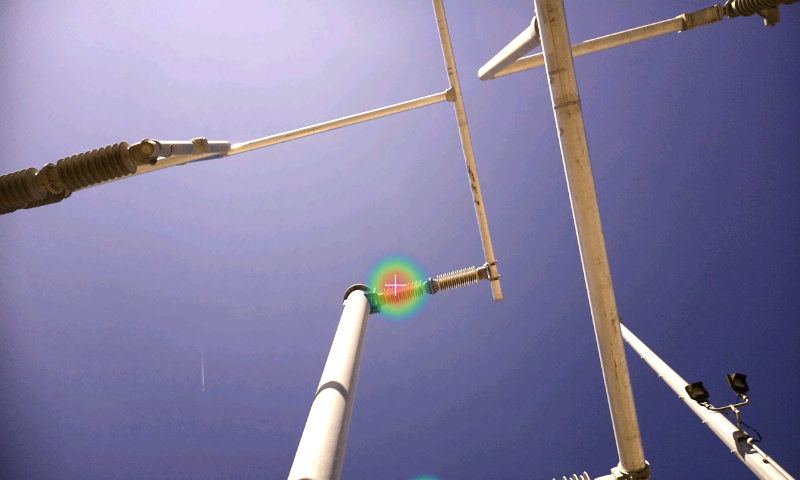
Partial discharge is the failure mode that gives the least warning. A discharge emits ultrasound, above the range of human hearing, so it is usually inaudible from the ground, and by the time an insulator flashes over the outage has already happened. Infrared shows the heat a discharge eventually produces; it does not show the discharge itself.
We run a FLIR Si-Series acoustic imaging camera with partial discharge classification. Its microphone array locates the ultrasonic source and overlays it on a live camera image from a safe standoff distance. The camera then classifies the discharge as negative corona, positive and negative corona, floating discharge, or surface or internal discharge, rates its severity from low to very high, and gives a recommended action. That distinction matters, because corona on a fitting and surface discharge across a contaminated insulator are different problems with different repairs.
In one survey of a 230 kV overhead line, the camera resolved discharge on a glass standoff insulator at 46.9 dB from five meters, classified it as surface or internal discharge, and rated it very high severity: strong enough that it might rapidly escalate to complete insulation breakdown. The standoff was also showing high thermal stress. The recommendation was immediate action: visual inspection, cleaning of the polluted surfaces, then repair or replacement of the component.
Service Area FAQ
Don’t see your question? Call (833) 723-2723 and talk to a technician.
Which counties do you cover from your California base?
Our headquarters is at 77 West Street in Woodland, in Yolo County. The counties we reach most routinely are Sacramento, Placer, Solano, Yuba, Sutter, El Dorado, Amador and Calaveras: the Sacramento Valley floor and the Sierra foothills above it. Sacramento is about twenty miles away; the farthest of these, Calaveras, is roughly two hours. This is a core region where we mobilize fastest, not a boundary. We work nationwide from bases in Woodland, California and Conner, Montana.
Do you only work in Northern California?
No. Substation Solutions is a nationwide practice covering roughly 50,000 field miles a year, with 24-hour mobilization to most of the continental United States and a field shop in Conner, Montana. Published field work includes an SF6 manifold repair in Texas. The county pages exist because proximity and local grid knowledge matter in procurement, not because our scope stops at a county line.
Do you work for utilities, or for customer-owned substations?
Both. We work for whoever owns the asset. Across this region that includes municipal and investor-owned utility infrastructure, federal transmission, irrigation and water district hydro switchyards, and a growing amount of customer-owned high-voltage equipment behind the meter at data centers, water and wastewater plants, hospital and university campuses, military installations and industrial sites. Our scope runs 12 kV through 500 kV regardless of the interconnecting utility.
What changes about maintenance at Sierra foothill elevations?
Two things. Above 3,000 feet CPUC General Order 95 places lines in a heavy loading district, which changes the ice and wind loading assumptions the structures were designed to. And access becomes the constraint rather than the work itself: a switchyard reachable in ninety minutes in July may need a different plan in February. Foothill maintenance is best sequenced into the dry season, with condition assessment done early enough that a finding can still be acted on before winter.
Can you detect partial discharge without an outage?
Yes. We run a FLIR Si-Series acoustic imaging camera with partial discharge classification, which locates the ultrasonic signature of a discharge against a live camera image from a safe standoff distance, with the equipment energized and under normal load. It separates corona from floating discharge and from surface or internal discharge, and rates severity. It complements infrared rather than replacing it: thermography shows the heat a discharge eventually produces, while acoustic imaging shows the discharge itself.
Tell Us Where the Equipment Is
Whether it is an SF6 inspection ahead of a CARB inventory, a breaker overhaul, an acoustic survey on energized gear, or a maintenance program built around what this region actually does to insulation, tell us what you have and we will tell you what it needs.