
Substation Services in Sacramento County, California
Our headquarters sits in Woodland, about twenty miles from downtown Sacramento. That puts most substations in the county inside a forty-five minute drive, whether the equipment is interconnected to SMUD, to PG&E along the Delta, or owned outright by a private or institutional operator. We service SF6-insulated equipment, circuit breakers, transformers and DC systems from 12 kV distribution through 500 kV transmission class.
- ~20 miles
- Woodland HQ to downtown
- 12–500 kV
- Distribution to transmission
- 24-hour
- Emergency mobilization
- Documented
- EPA and CARB reporting
Who owns high-voltage equipment in Sacramento County
Sacramento County is unusual in Northern California: the dominant utility is community-owned rather than investor-owned, the state's grid operator is headquartered here, and a growing share of high-voltage equipment belongs to customers rather than to a utility at all. Knowing which of those you are dealing with changes the outage coordination, the switching order and the documentation the job has to produce.
Sacramento Municipal Utility District
SMUD serves roughly 900 square miles covering most of Sacramento County plus small adjoining portions of Placer and Yolo, with about 673,000 accounts and more than 11,000 miles of line. It is the sixth-largest community-owned electric utility in the country, it operates the Balancing Authority of Northern California, and it is in the middle of a substantial substation investment program driven by load growth.
Pacific Gas and Electric Company
PG&E's electric footprint in the county is small, on the order of a couple of thousand customers concentrated along the Delta fringe near Isleton and Walnut Grove. PG&E remains the natural gas utility countywide, and its Brighton substation on Folsom Boulevard sits inside the county.
Western Area Power Administration
WAPA's Sierra Nevada region is headquartered in Folsom and operates roughly 884 miles of 69 kV to 500 kV transmission across Northern California. Its Elverta 230 kV substation sits in the county, and the O'Banion to Elverta line ties it northward into the Sacramento Valley transmission network.
California ISO
The California Independent System Operator is headquartered on Outcropping Way in Folsom. Sacramento County is therefore one of the few places in the country where a balancing authority, a major municipal utility and the state grid operator all sit inside the same county line, which shapes how outage windows get negotiated.
Generation switchyards
SMUD operates roughly a gigawatt of gas generation in the county, including the 600 MW Cosumnes Power Plant near Herald along with the Carson, Campbell, Procter and McClellan plants. The Bureau of Reclamation's Folsom Powerplant adds close to 200 MW, and the former Rancho Seco site now hosts utility-scale solar. Every one of those has a switchyard with its own maintenance obligations.
Private and institutional substations
This is the fastest-growing category in the county. Data centers cluster in Natomas, McClellan Park and Rancho Cordova, ranging from a few megawatts up to campuses in the 40 to 50 MW range, and SMUD is developing a large-load policy for customers at 50 MW and above. Add regional transit traction power substations, wastewater treatment facilities, hospital campuses and industrial plants, and a large share of the county's high-voltage equipment sits behind a customer meter.
What the Sacramento Valley does to substation equipment
Maintenance intervals published in a standard assume an average environment. Sacramento County is not average in three specific ways, and each one drives a different failure mode. These are the conditions we plan a maintenance program around here.
-
Sustained triple-digit heat
Sacramento averages roughly twenty-three days at or above 100°F in a normal year and set a record of forty-five such days in 2024. Sustained ambient heat pushes transformer top-oil and winding temperatures up, increases load tap changer duty, and exposes cooling fan and pump failures that stay hidden through a mild spring. The useful window for infrared thermography is narrower than it looks. A survey needs equipment under meaningful load, and industry practice calls for at least 40% of normal load, but running the survey during the worst of the heat season means finding problems at the moment you can least afford an outage. The sensible sequence is to survey ahead of the heat and to treat cooling system verification as a spring task rather than a summer one.
-
Tule fog and insulator contamination
Radiation fog settles across the valley floor from roughly November through March, typically with visibility under 600 feet. The fog itself is a driving hazard, not an equipment hazard. The equipment hazard is what it does to insulators that are already dirty. Light wetting is worse than heavy rain: fog and dew dissolve deposited salts and agricultural residue without washing them off the surface, and uneven drying produces dry-band arcing, the standard precursor to pollution flashover. In a county that sits downwind of hundreds of thousands of acres of row crop and orchard, insulator condition assessment is better placed in the autumn schedule, before the first fog, than in a post-incident investigation. Surface discharge across a contaminated insulator emits in the ultrasonic band well before anything is visible from the ground, which is what makes an acoustic survey the practical way to catch it while the equipment stays energized.
-
Natomas Basin flood exposure
The Natomas Basin has been federally assessed as one of the nation's most at-risk areas for catastrophic flooding, with underseepage exposed by the 1997 and 2006 storms. A forty-two mile levee ring protects it; roughly eighteen miles have been improved and federal work continues on the remainder. For any facility inside the basin, the vulnerable assets are the ones below grade. Cable trenches, conduit entries, ground grid connections and battery rooms are where a high water table and a saturated subgrade actually show up, usually as slow corrosion and rising ground resistance rather than a dramatic failure. DC system testing and ground grid integrity checks carry more weight here than they would on higher ground.
What we perform in Sacramento County
The scope we deliver, mapped to the asset mix here: gas-insulated equipment across a dense urban distribution network, transmission-class breakers at the county's switching nodes, and customer-owned gear of the kind found at data centers, treatment plants and campuses.
-
SF6 Leak Detection & Repair
Infrared imaging and portable analyzers to locate leaks, leak-rate quantification for the repair decision and for reporting, root-cause repair at seals and manifold connections, and documented post-repair verification. Directly relevant to CARB inventory and emission-limit obligations.
-
Circuit Breaker Repair & Refurbishment
Full remanufacture to factory specification from 12 kV through 500 kV: disassembly, cleaning and inspection, OEM-quality parts, mechanism overhaul, and post-refurbishment testing before anything returns to service.
-
Preventive Maintenance & Diagnostics
Infrared thermography graded against NETA Table 100.18, acoustic imaging for partial discharge, DC battery installation and testing, and maintenance programs built around condition rather than the calendar. The heat and fog cycle here makes seasonal sequencing worth getting right.
-
High Voltage Consulting
Testing and commissioning including relay work, root-cause analysis, equipment lifecycle planning, safety and procedure review, and upgrade planning. Useful where a customer owns transmission-class equipment without an in-house specialist team.
-
Methane Leak Detection
Calibrated optical gas imaging for methane, applicable at gas-fired generation and adjacent pipeline and compressor assets. Reports give pinpointed leak locations, severity estimates and compliance-ready documentation.
Acoustic Imaging for Partial Discharge
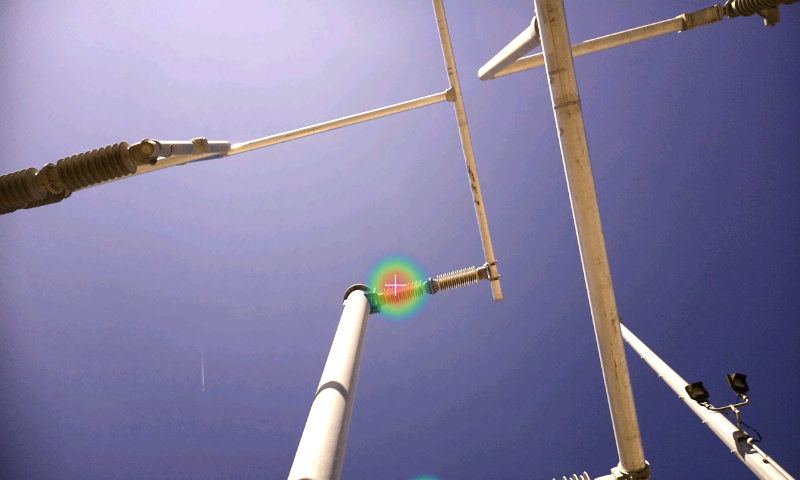
Partial discharge is the failure mode that gives the least warning. A discharge emits ultrasound, above the range of human hearing, so it is usually inaudible from the ground, and by the time an insulator flashes over the outage has already happened. Infrared shows the heat a discharge eventually produces; it does not show the discharge itself.
We run a FLIR Si-Series acoustic imaging camera with partial discharge classification. Its microphone array locates the ultrasonic source and overlays it on a live camera image from a safe standoff distance. The camera then classifies the discharge as negative corona, positive and negative corona, floating discharge, or surface or internal discharge, rates its severity from low to very high, and gives a recommended action. That distinction matters, because corona on a fitting and surface discharge across a contaminated insulator are different problems with different repairs.
In one survey of a 230 kV overhead line, the camera resolved discharge on a glass standoff insulator at 46.9 dB from five meters, classified it as surface or internal discharge, and rated it very high severity: strong enough that it might rapidly escalate to complete insulation breakdown. The standoff was also showing high thermal stress. The recommendation was immediate action: visual inspection, cleaning of the polluted surfaces, then repair or replacement of the component.
The regulatory picture for California operators
California asset owners carry obligations that operators in other states do not. We build the documentation into the job rather than producing it afterward.
CARB gas-insulated equipment rule
The California Air Resources Board's regulation on gas-insulated equipment, adopted in 2021 and in effect since 2022, phases out acquisition of new SF6 equipment by voltage class and short-circuit rating on dates running from 2025 to 2033. It pairs that with an annual CO2e emission limit, inventory and gas-handling records, and a yearly report due June 1. Existing equipment can stay in service, which puts leak rate and verified repairs at the center of the compliance record.
EPA greenhouse gas reporting
Under Subpart DD of the EPA Greenhouse Gas Reporting Program, owners of electrical transmission and distribution equipment report SF6 once estimated emissions reach 25,000 metric tons CO2e, the basis in force since reporting year 2025. EPA proposed removing Subpart DD in September 2025 but has not finalized that change, so the obligation stands; confirm the current status before relying on it either way.
NFPA 70B
NFPA 70B became a mandatory maintenance standard with its 2023 edition, calling for infrared inspection at least every twelve months, and every six months for equipment in the poorest physical condition. The 2026 edition, now current, also recognizes permanently installed continuous temperature monitoring. Thermography is on a fixed schedule rather than a discretionary one.
ANSI/NETA MTS-2023
The current maintenance testing specification, approved in March 2023, underpins the test intervals and acceptance criteria we work to. Its Chapter 7 sets out inspection and test procedures for substation equipment, circuit breakers among it, and our thermographic grading follows the NETA Table 100.18 temperature-difference thresholds.
Sacramento County FAQ
Don’t see your question? Call (833) 723-2723 and talk to a technician.
How quickly can you reach a substation in Sacramento County?
Our headquarters is at 77 West Street in Woodland, roughly twenty miles from downtown Sacramento. Most sites in the county are inside a forty-five minute drive, and outlying areas such as Galt, Isleton and Herald are typically around an hour. For emergency work we mobilize within 24 hours to most of the continental United States, but Sacramento County is effectively local to us.
Can you work on equipment interconnected to SMUD or to PG&E?
Yes. We work for whoever owns the asset. Most of the county is served by SMUD, with a small PG&E footprint along the Delta near Isleton, but a large share of high-voltage equipment here is customer-owned: data centers, transit traction power, water and wastewater facilities, campuses and industrial plants all operate their own substations. Our scope runs 12 kV through 500 kV regardless of the interconnecting utility.
How does Sacramento heat affect maintenance scheduling?
Sacramento averages roughly twenty-three days at or above 100°F per year and set a record of forty-five in 2024. Sustained heat drives transformer top-oil and winding temperature rise, increases load tap changer duty, and exposes cooling fan and pump failures that would go unnoticed in mild weather. It also compresses the useful window for infrared thermography, since a survey needs equipment under meaningful load and industry practice calls for at least 40% of normal load. In practice that means running the thermographic survey before the heat season rather than during it, and treating cooling system verification as a spring task.
Why does winter tule fog matter for substation equipment?
Tule fog forms across the valley from about November through March, usually with visibility under 600 feet. The risk is not the fog but what it does to already-contaminated insulators. Light wetting dissolves deposited salts and agricultural residue without washing them off, which is the classic condition for dry-band arcing and pollution flashover. Insulator condition assessment is best done before the fog season, not after a flashover.
Can you find partial discharge without taking equipment out of service?
Yes. We run a FLIR Si-Series acoustic imaging camera with partial discharge classification, which locates the ultrasonic signature of a discharge against a live camera image from a safe standoff distance, with the equipment energized and under normal load. The camera separates corona from floating discharge and from surface or internal discharge, and rates severity, so a finding comes with both a diagnosis and an urgency. It complements infrared rather than replacing it: thermography shows the heat a discharge eventually produces, while acoustic imaging shows the discharge itself.
Let’s Look at Your Sacramento County Assets
Whether it is an SF6 inspection ahead of a CARB inventory, a breaker overhaul, or a maintenance program built around what this valley actually does to equipment, our technicians can be on site quickly. Tell us what you have and we will tell you what it needs.