Substation Services in Solano County, California
Solano County sits between the Sacramento Valley and San Francisco Bay, where the Delta breeze pours through the Carquinez Strait and the Montezuma Hills carry more than 800 MW of wind generation. It holds a 500 kV transmission node, an air base, and substations built on the soft ground at the edge of the Delta. Fairfield is about 40 miles from our Woodland shop, well under an hour, and we service equipment across the county from 12 kV through 500 kV.
- ~40 miles
- Woodland shop to Fairfield, approx.
- 500 kV
- Vaca-Dixon transmission node
- 800+ MW
- Wind in the Montezuma Hills
- 24-hour
- Emergency mobilization
Who owns high-voltage equipment in Solano County
Solano's grid is transmission-heavy for a county its size. A century-old 500 kV node feeds the Bay Area, wind collector stations line the southern hills, a new 500/230 kV substation is in permitting, and one of the county's largest loads runs a privately owned distribution system behind a military fence.
Vaca-Dixon substation
PG&E's Vaca-Dixon substation near Vacaville carries 500 kV, 230 kV and 115 kV service, including the Vaca Dixon–Tesla 500 kV line. It was energized in 1922, reported at the time as the largest substation in the world, and it remains one of the gateways that carry power into the Bay Area.
Pacific Gas and Electric Company and MCE
PG&E owns the wires and delivers power across the county, while MCE, the community choice aggregator, buys generation for Benicia, Fairfield, Vallejo and the unincorporated county. The split matters in the field: the wires owner, not the power buyer, governs switching and clearances.
SMUD Solano Wind Farm
The Sacramento Municipal Utility District's Solano Wind Farm covers about 6,000 acres of the Montezuma Hills and a little over 300 MW after its latest repowering, tying in at SMUD's Russell substation. Nearby, PG&E's Birds Landing switching station collects the Shiloh wind projects at 230 kV.
Travis Air Force Base
The base's electrical distribution system is privatized, owned and operated by a contractor rather than the Air Force. The Department's fiscal 2026 energy resilience budget funds a $25 million microgrid at Travis with solar, a 1.5 MW battery, emergency gas generation, new switchgear and microgrid controls.
Collinsville 500/230 kV
LS Power Grid California is permitting a new 500/230 kV substation near Collinsville in the south of the county, under CPUC review with a target in-service date of June 2028. Battery projects of 157 MW and 300 MW are also proposed near Vaca-Dixon, under a county storage ordinance adopted in August 2025.
Fairfield-Suisun Sewer District
The district's treatment plant takes service from two utility feeders and runs its own cogeneration, solar and small wind generation, the kind of mixed on-site system that needs protection and interconnection equipment maintained like any substation.
What the Delta gap does to substation equipment
Solano does not behave like the valley an hour to the east. Marine air, relentless wind, fire in the eastern hills and soft ground at the Delta edge each wear equipment down in their own way.
-
Marine air through the Carquinez Strait
The Carquinez Strait is a sea-level gap in the Coast Ranges, and on summer afternoons the Delta breeze funnels marine air through it toward Fairfield and Vacaville. That air carries moisture and salt inland, and both settle on insulators, bushings and hardware. The result is a coastal failure pattern forty miles from the ocean: surface leakage and arcing across contaminated insulators, and corrosion on connections and enclosures. Cleaning intervals and connection checks here should be set by exposure, not copied from a valley substation an hour east.
-
Constant wind in the Montezuma Hills
The Montezuma Hills were set aside for wind development in 1987 for the speed and consistency of the wind, and more than 800 MW of turbines now stand there. Constant wind means constant mechanical load: conductor motion and fatigue at terminations, vibration on bus supports, and hardware that works loose over years. Collector substations also see heavy switching and protection duty as output swings. Torque checks, connection thermography and breaker operation counts matter more here than the calendar suggests.
-
Fire in the eastern hills
The 2020 LNU Lightning Complex burned 41,776 acres in Solano County and destroyed or damaged 854 structures there. Beyond direct damage, fire season brings smoke and ash deposits on insulators, public safety power shutoffs, and fast-trip protection settings that add operations to every breaker on an affected circuit. A contamination and breaker condition check after fire season catches what the season left behind.
-
Peat soils at the Delta edge
Around Suisun Marsh and the Delta, peat soils subside roughly one to two centimeters a year over a shallow water table. For any substation on that ground, the slow failures are below grade: settling foundations, strained ground grid connections, and water standing in cable trenches. Ground grid resistance testing and trench inspections belong in the maintenance plan wherever the ground moves.
What we perform in Solano County
The scope we deliver, framed to Solano's asset mix: a 500 kV transmission node, wind collector substations, institutional and treatment-plant loads, and equipment breathing marine air.
-
SF6 Leak Detection & Repair
Leak detection and repair on gas-insulated breakers at transmission and collector substations, where years of wind-driven vibration work seals and fittings loose. Leak rates and verified repairs are documented for the CARB record.
-
Circuit Breaker Repair & Refurbishment
Refurbishment to factory specification from 12 kV through 500 kV, with close attention to mechanisms and contacts that see frequent operation at wind collector stations and extra trips during fire season.
-
Preventive Maintenance & Diagnostics
Maintenance built for the Delta breeze: insulator condition assessment, connection thermography, corrosion inspection, ground grid testing on soft ground, and DC system checks.
-
High Voltage Consulting
Commissioning and relay testing as the county's storage and transmission projects move toward construction, plus condition assessments and lifecycle planning for older transmission-class equipment.
-
Methane Leak Detection
Optical gas imaging for methane at gas-fired peaking plants and their associated pipeline equipment, with pinpointed leak locations and severity estimates ready for the compliance file.
Acoustic Imaging for Partial Discharge
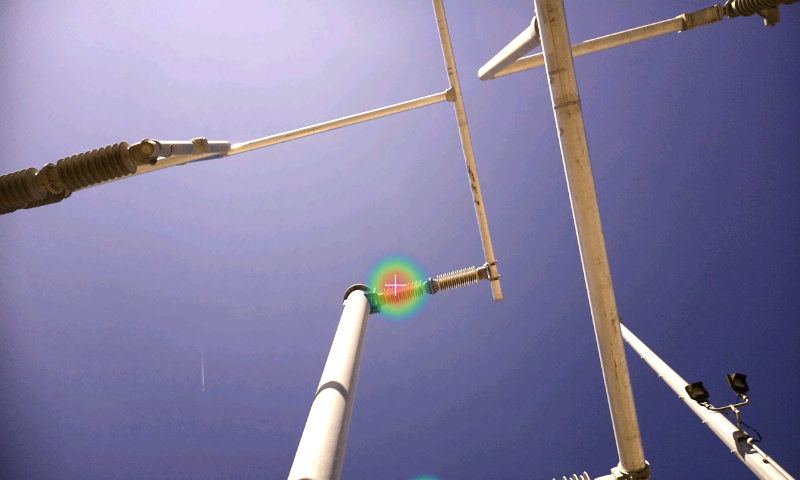
Partial discharge is the failure mode that gives the least warning. A discharge emits ultrasound, above the range of human hearing, so it is usually inaudible from the ground, and by the time an insulator flashes over the outage has already happened. Infrared shows the heat a discharge eventually produces; it does not show the discharge itself.
We run a FLIR Si-Series acoustic imaging camera with partial discharge classification. Its microphone array locates the ultrasonic source and overlays it on a live camera image from a safe standoff distance. The camera then classifies the discharge as negative corona, positive and negative corona, floating discharge, or surface or internal discharge, rates its severity from low to very high, and gives a recommended action. That distinction matters, because corona on a fitting and surface discharge across a contaminated insulator are different problems with different repairs.
In one survey of a 230 kV overhead line, the camera resolved discharge on a glass standoff insulator at 46.9 dB from five meters, classified it as surface or internal discharge, and rated it very high severity: strong enough that it might rapidly escalate to complete insulation breakdown. The standoff was also showing high thermal stress. The recommendation was immediate action: visual inspection, cleaning of the polluted surfaces, then repair or replacement of the component.
The regulatory picture for California operators
California asset owners carry obligations that operators in other states do not. We build the documentation into the job rather than producing it afterward.
CARB gas-insulated equipment rule
The California Air Resources Board's regulation on gas-insulated equipment, adopted in 2021 and in effect since 2022, phases out acquisition of new SF6 equipment by voltage class and short-circuit rating on dates running from 2025 to 2033. It pairs that with an annual CO2e emission limit, inventory and gas-handling records, and a yearly report due June 1. Existing equipment can stay in service, which puts leak rate and verified repairs at the center of the compliance record.
EPA greenhouse gas reporting
Under Subpart DD of the EPA Greenhouse Gas Reporting Program, owners of electrical transmission and distribution equipment report SF6 once estimated emissions reach 25,000 metric tons CO2e, the basis in force since reporting year 2025. EPA proposed removing Subpart DD in September 2025 but has not finalized that change, so the obligation stands; confirm the current status before relying on it either way.
NFPA 70B
NFPA 70B became a mandatory maintenance standard with its 2023 edition, calling for infrared inspection at least every twelve months, and every six months for equipment in the poorest physical condition. The 2026 edition, now current, also recognizes permanently installed continuous temperature monitoring. Thermography is on a fixed schedule rather than a discretionary one.
ANSI/NETA MTS-2023
The current maintenance testing specification, approved in March 2023, underpins the test intervals and acceptance criteria we work to. Its Chapter 7 sets out inspection and test procedures for substation equipment, circuit breakers among it, and our thermographic grading follows the NETA Table 100.18 temperature-difference thresholds.
Solano County FAQ
Don’t see your question? Call (833) 723-2723 and talk to a technician.
How quickly can you reach a site in Solano County?
Fairfield, the county seat, is about 40 miles from our Woodland shop, typically well under an hour, and Vacaville and Dixon are closer. Benicia and Vallejo at the south end of the county run a little longer depending on Interstate 80 traffic. Those drive times are approximate and meant to set expectations rather than to serve as a response commitment.
Why does marine air matter for substations in Fairfield and Vacaville?
Because the Carquinez Strait funnels the Delta breeze inland, equipment in the western and central county sees salt and moisture that valley substations never do. Contaminated insulators leak current and arc across their surfaces in damp conditions, and hardware corrodes faster. Inspection and cleaning intervals should reflect that exposure.
Can you maintain wind collector substations?
Yes. Collector stations in wind country see constant vibration and frequent switching as output rises and falls, which makes connection integrity, breaker operation counts and SF6 seal condition the priorities. The equipment gets the same standard as any substation: manufacturer specification and NETA acceptance criteria.
What changes about maintenance near Suisun Marsh and the Delta?
The ground. Peat soils there subside by roughly one to two centimeters a year over a shallow water table, so foundations settle, ground grid connections strain, and cable trenches take on water. Periodic ground grid resistance testing and below-grade inspection catch those slow failures before they show up as a protection problem.
Can you work on privatized or military distribution systems?
Yes. We work for whoever owns the asset, and on a military installation that is often a private system owner rather than the base itself. Base access, escort and scheduling requirements add lead time, so it helps to mention them when requesting a quote.
Equipment in the Delta Breeze Ages Faster
Whether it is a transmission-class breaker, a wind collector station or a treatment plant's switchgear, tell us what you have and we will tell you what it needs.