Substation Services in Yuba County, California
Yuba County runs from the levee-ringed floodplain where the Feather and Yuba rivers meet at Marysville, up into foothill canyons holding the largest hydro plant on the Yuba River. It is flood country at one end and fire country at the other, and both leave a mark on equipment. Marysville is about 40 miles from our Woodland shop, roughly fifty minutes, and we service utility, federal, public-agency and customer-owned equipment across the county from 12 kV through 500 kV.
- ~40 miles
- Woodland shop to Marysville, approx.
- 417 MW
- Yuba River hydro capacity
- 12–500 kV
- Distribution to transmission
- 24-hour
- Emergency mobilization
Who owns high-voltage equipment in Yuba County
Yuba's grid combines a public water agency's hydro system, an investor-owned utility's century-old 115 kV lines, federal 230 kV transmission and an air base planning its own new substation. One of the county's largest generators is also recovering from a switchyard flood this year.
Yuba Water Agency
The Yuba River Development Project (FERC P-2246) can produce up to 417 MW, led by the 350 MW New Colgate powerhouse near Dobbins and the 55 MW Narrows 2 below Englebright Dam. The agency sells its power into the California ISO market rather than to retail customers, and operates the project under annual FERC licenses while relicensing continues.
New Colgate penstock rupture
On February 13, 2026 a penstock at New Colgate ruptured, releasing about 400 acre-feet of water and flooding the two switchyards the powerhouse shares with PG&E. The plant has been offline since, with repairs expected to take a year or more, and Narrows 2 lost its backup station power from Colgate for about two hours.
Pacific Gas and Electric Company
PG&E serves the county's retail load over a 230, 115 and 60 kV network. Three Palermo–Rio Oso 115 kV lines, on towers built in the early 1900s, run through Yuba and Sutter counties, and the Marysville area is served from substations including Marysville and East Marysville.
Western Area Power Administration
WAPA's Cottonwood–Roseville 230 kV line crosses the county about six miles west of Beale Air Force Base, and it is the line the base's planned interconnection would tap.
Beale Air Force Base
Beale takes its federal power today over a single utility pole line. A federal environmental assessment finalized in 2020 covers a five-mile 230/60 kV tie from the WAPA line to the base, including a new on-base substation.
Olivehurst Public Utility District
The district's wastewater plant is being expanded into the regional plant for Wheatland, a first phase of about $155 million, adding the kind of pumping and process load that brings its own switchgear and transformers.
What floodplain and foothills do to substation equipment
Yuba's history is written in levee breaks and fire perimeters. These are the conditions that shape how equipment here fails, and what a maintenance plan has to cover because of them.
-
Levees at the river confluence
Marysville sits where the Feather and Yuba rivers meet, inside a 7.6-mile ring levee rebuilt with seepage cutoff walls, relief wells and berms. The county has seen what happens when levees fail: in February 1986 the Yuba River levee broke at Linda, flooding about 30 square miles and forcing more than 26,000 people to evacuate, and on New Year's 1997 the Feather River levee failed at Arboga. For equipment behind those levees, the exposure is below grade and above it: cable trenches, ground grids and battery rooms that sit in saturated ground for weeks, and control buildings that can take water in a breach.
-
Hydro switchyards below the water
The New Colgate rupture in February 2026 shows a failure mode peculiar to hydro sites: the switchyard often sits directly below the water that drives the plant. A penstock or tailwater failure becomes a flood of the yard itself, with debris against equipment, water in control cable trenches and loss of station service. At a hydro switchyard, drainage, trench sealing, station batteries and backup station service deserve the same scrutiny as the breakers.
-
Wind-driven fire in the foothills
The Cascade Fire started in October 2017 north of Collins Lake, burned 9,989 acres, destroyed 264 structures and killed four people. CAL FIRE found that wind pushed sagging conductors into contact with one another. Conductor sag, clearance and hardware condition are therefore maintenance items in their own right on foothill circuits, and after any fire nearby, insulators and bushings need to be checked for smoke and ash contamination.
-
Valley heat and rice-field dust
Marysville's July highs average about 96°F, and rice is the county's leading crop. Harvest dust and field residue settle on insulators through the autumn, then winter valley fog wets them without washing them clean. That combination of heat stress on transformers in summer and contamination flashover risk in winter makes a spring infrared survey and an autumn insulator assessment the two anchor points of the year here.
What we perform in Yuba County
The scope we deliver, framed to Yuba's asset mix: hydro switchyards in the canyons, distribution substations behind the levees, a military load building new infrastructure, and treatment plants expanding with the south county.
-
SF6 Leak Detection & Repair
Leak detection and repair on gas-insulated breakers at hydro and distribution switchyards, with leak-rate quantification, root-cause seal repair and post-repair verification documented for the CARB record.
-
Circuit Breaker Repair & Refurbishment
Remanufacture to factory specification, 12 kV through 500 kV, including post-flood inspection and refurbishment of mechanisms and control wiring that have taken on water or silt.
-
Preventive Maintenance & Diagnostics
Flood-aware maintenance behind the levees: ground grid integrity testing, cable trench and DC system inspection, plus spring thermography ahead of the heat and autumn insulator assessment before the fog.
-
High Voltage Consulting
Condition assessment and root-cause analysis after flood or fire, commissioning and relay testing for new interconnections and on-site substations, and restoration planning for damaged switchyards.
-
Methane Leak Detection
Optical gas imaging for methane at gas-fired equipment and associated pipeline and compressor assets, with pinpointed leak locations and severity estimates for the compliance file.
Acoustic Imaging for Partial Discharge
Partial discharge is the failure mode that gives the least warning. A discharge emits ultrasound, above the range of human hearing, so it is usually inaudible from the ground, and by the time an insulator flashes over the outage has already happened. Infrared shows the heat a discharge eventually produces; it does not show the discharge itself.
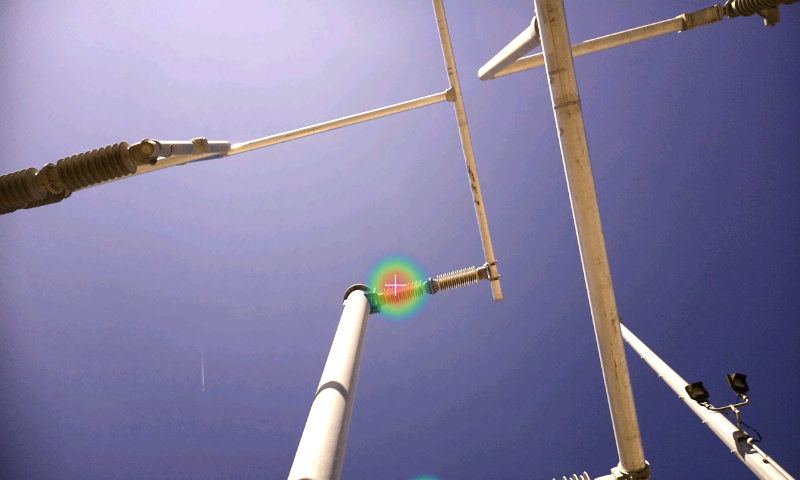
We run a FLIR Si-Series acoustic imaging camera with partial discharge classification. Its microphone array locates the ultrasonic source and overlays it on a live camera image from a safe standoff distance. The camera then classifies the discharge as negative corona, positive and negative corona, floating discharge, or surface or internal discharge, rates its severity from low to very high, and gives a recommended action. That distinction matters, because corona on a fitting and surface discharge across a contaminated insulator are different problems with different repairs.
In one survey of a 230 kV overhead line, the camera resolved discharge on a glass standoff insulator at 46.9 dB from five meters, classified it as surface or internal discharge, and rated it very high severity: strong enough that it might rapidly escalate to complete insulation breakdown. The standoff was also showing high thermal stress. The recommendation was immediate action: visual inspection, cleaning of the polluted surfaces, then repair or replacement of the component.
The regulatory picture for California operators
California asset owners carry obligations that operators in other states do not. We build the documentation into the job rather than producing it afterward.
CARB gas-insulated equipment rule
The California Air Resources Board's regulation on gas-insulated equipment, adopted in 2021 and in effect since 2022, phases out acquisition of new SF6 equipment by voltage class and short-circuit rating on dates running from 2025 to 2033. It pairs that with an annual CO2e emission limit, inventory and gas-handling records, and a yearly report due June 1. Existing equipment can stay in service, which puts leak rate and verified repairs at the center of the compliance record.
EPA greenhouse gas reporting
Under Subpart DD of the EPA Greenhouse Gas Reporting Program, owners of electrical transmission and distribution equipment report SF6 once estimated emissions reach 25,000 metric tons CO2e, the basis in force since reporting year 2025. EPA proposed removing Subpart DD in September 2025 but has not finalized that change, so the obligation stands; confirm the current status before relying on it either way.
NFPA 70B
NFPA 70B became a mandatory maintenance standard with its 2023 edition, calling for infrared inspection at least every twelve months, and every six months for equipment in the poorest physical condition. The 2026 edition, now current, also recognizes permanently installed continuous temperature monitoring. Thermography is on a fixed schedule rather than a discretionary one.
ANSI/NETA MTS-2023
The current maintenance testing specification, approved in March 2023, underpins the test intervals and acceptance criteria we work to. Its Chapter 7 sets out inspection and test procedures for substation equipment, circuit breakers among it, and our thermographic grading follows the NETA Table 100.18 temperature-difference thresholds.
Yuba County FAQ
Don’t see your question? Call (833) 723-2723 and talk to a technician.
How far is Yuba County from your Woodland shop?
Marysville, the county seat, is about 40 miles from our Woodland shop, roughly fifty minutes by State Route 113. Foothill sites around Dobbins, Brownsville and Camptonville take longer on narrow roads. Treat those times as approximate; the response time for a specific site is confirmed when we quote.
What should be checked after a flood reaches a substation?
Everything that sat in water or saturated ground: ground grid connections and resistance, cable trenches and terminations, DC batteries and chargers, and breaker control wiring and mechanisms. Insulation resistance and power factor testing on affected transformers and bushings belongs in the same visit, before anything is put back under full load.
Can you help restore a hydro switchyard after water damage?
Yes. Restoration work covers assessment of flooded breakers, transformers and control equipment, cleaning and drying, testing to acceptance criteria, and refurbishment or replacement where testing shows it is needed. Documentation of findings and verified repairs supports the insurance and regulatory record.
How does fire risk in the Yuba foothills affect maintenance?
It adds items that valley substations do not need: conductor sag and clearance checks, hardware inspection on wind-exposed spans, and post-fire cleaning and surveys for smoke and ash contamination. The Cascade Fire of 2017 is the local reminder of why those checks matter.
Do you work on equipment at military installations?
Yes. We work for whoever owns the asset, whether that is a utility, an agency, a private system owner or a federal installation. Security and escort requirements on a base add lead time, so they are worth mentioning when requesting a quote.
Behind the Levees and Up the Canyons
Whether it is a distribution substation on the floodplain, a hydro switchyard recovering from water damage or a new interconnection, tell us what you have and we will tell you what it needs.