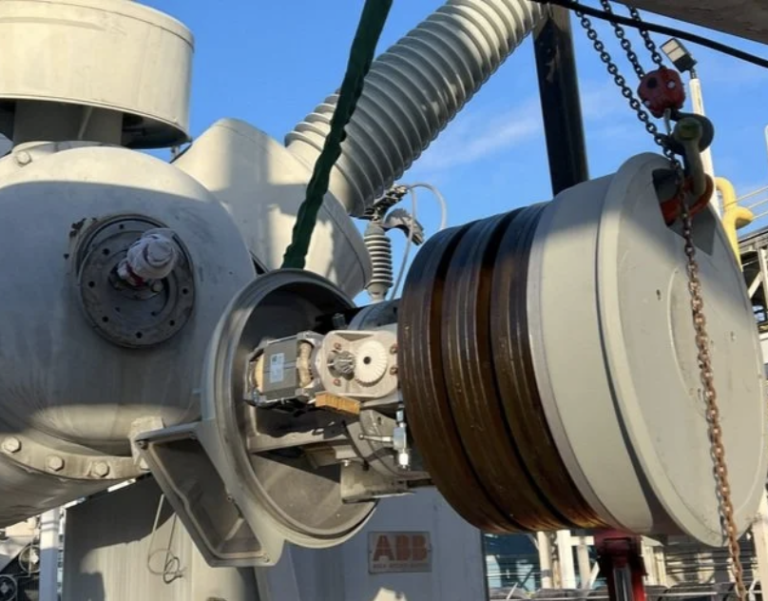
High-voltage circuit breakers are classified by the medium that extinguishes the arc: SF6 gas, vacuum, oil, or compressed air. SF6 breakers dominate new transmission work, generally above 52 kV and up to 800 kV, while vacuum interrupters serve mostly 38 kV class and below. Oil and air-blast designs remain in service but are no longer the choice for new builds. The type you own sets the maintenance plan: SF6 units need gas density and leak management, vacuum units need vacuum integrity checks, and oil units need oil and contact inspection. A service plan that does not match the interrupting medium is one of the most common gaps in a breaker program, at every voltage class from 12 kV through 500 kV.
How Each Breaker Type Interrupts the Arc
Every breaker has the same job: open under load or fault and extinguish the arc at a current zero. The medium decides how it gets there, and that is what drives inspection, testing, and lifecycle cost.
SF6 breakers use sulfur hexafluoride, a gas with higher dielectric strength than air, which allows compact designs. The puffer design, introduced in 1957, compresses gas during the opening stroke and blasts it through a nozzle at the arc. The self-blast design, used since about 1980, lets the arc’s own energy build pressure in an expansion volume. One caution applies to both: low gas density reduces dielectric strength, some designs block operation when density is low, and at very low outdoor temperatures SF6 can liquefy and reduce interrupting ability.
Vacuum breakers deposit arc products on a metallic shield around the contacts, and with nothing to sustain it, the arc goes out quickly. In oil breakers the arc decomposes the surrounding oil into a hydrogen-rich gas bubble that cools the arc, while arc-control chambers around the contacts force oil across it. Air-blast breakers, used at the very highest voltages (a reference source cites 765 kV and above), are no longer manufactured, so owners of legacy units are usually managing parts availability as much as performance.
Which Voltage Classes Use Which Type
Voltage class is the quickest filter when you are sorting a fleet. These ranges come from published industry references, and the nameplate always governs.
- SF6: generally used at rated voltages above 52 kV, and widely used at transmission voltages up to 800 kV, with some use down to 35 kV distribution.
- Vacuum: generally 38 kV class and below, covering most switchgear and some outdoor breakers.
- Oil: widely used in the past and now mostly replaced in new installations, though many remain in service.
- Air-blast: legacy equipment at the highest voltages, no longer manufactured.
For IEEE-based ratings, the C37.04 and C37.06 families define the rating structure and preferred ratings for AC high-voltage breakers, and C37.010 is the application guide. Pull the rated maximum voltage, continuous current, and short-circuit interrupting rating from the nameplate before comparing any two units.
Live Tank, Dead Tank, and GIS Configurations
Type is only half the picture, because the same interrupter can be packaged three ways. A live tank breaker mounts the interrupter on an insulating column at line potential. A dead tank breaker places the interrupter in a grounded tank, with bushings carrying the line connections. Gas-insulated switchgear (GIS) encloses the breaker and other apparatus in grounded gas-filled compartments. Each changes access for inspection, how gas compartments are isolated, and how long an outage takes to service. For a deeper look at equipment inventories, see our guide on where SF6 is used in substations.
What 2026 Is Changing: SF6-Free Models and State Rules
Three developments are reshaping breaker purchasing. First, manufacturers are moving SF6-free breakers up the voltage ladder. At CIGRE 2026, Hitachi Energy added a 245 kV dead tank breaker, a 300 kV GIS, and a 420 kV, 80 kA live tank breaker to its EconiQ portfolio, with orders from Hydro One and TenneT Germany. The company reports more than 4,000 EconiQ units ordered in 40 countries, which is a manufacturer claim worth verifying against your own specifications.
Second, the climate data keeps pressure on SF6. The WMO Greenhouse Gas Bulletin released October 27, 2026 reported a record increase in SF6 for 2025, and cites a 100-year global warming potential of 24,300 and an atmospheric lifetime above 1,000 years.
Third, state rules are layering on. California’s gas-insulated equipment regulation began phasing out new SF6 equipment on January 1, 2025, with end dates running through 2033 by voltage class, an annual report due June 1, no minimum reporting threshold, and five years of records. New York’s Part 495 starts a voltage-based phase-out in 2027 and sets a 1% systemwide emissions limit on a 3-year rolling average from 2030. Massachusetts sets a 1% maximum annual leak rate for GIS purchased after 2015. At the federal level, 40 CFR Part 98 Subpart DD applies at 25,000 metric tons of CO2 equivalent, estimated from nameplate capacity, starting with reporting year 2025; EPA proposed removing Subpart DD in September 2025, so confirm its current status. Meanwhile, 2026 trade coverage describes utilities scrambling for transformers and other grid equipment as data center demand strains supply, so keeping a serviceable breaker in service is a decision many owners are pricing against replacement.
What Each Type Needs From a Service Team
ANSI/NETA MTS-2023 Chapter 7 is the usual reference for breaker acceptance and maintenance testing. Core tests include contact (micro-ohm) resistance, insulation resistance, time-travel analysis, and, on SF6 units, gas pressure and leak checks. Beyond that, each type has its own priorities.
- SF6 breakers: gas density trending, SF6 gas analysis for moisture and decomposition products, and leak surveys with SF6 leak imaging. In one of our field jobs, a breaker drifting toward low-pressure lockout was topped off, tested, and returned to service before it locked out, which is the point of proactive gas management.
- Vacuum breakers: contact wear, mechanism timing, and vacuum integrity testing, since a lost vacuum has no gauge to warn you.
- Oil breakers: oil condition, contact erosion, tank and gasket leaks, and inspection of the arc-control chambers.
- All types: operating mechanism lubrication and adjustment, control circuit checks, and trip and close coil verification.
This is where field-led experience matters. Our founder, Brad Webb, served as an Electric Standards & Work Methods Specialist at PG&E before starting Substation Solutions, and we apply the same logic today: set the interval by the breaker’s medium, duty, and condition rather than by a single calendar rule. Our guide to testing intervals walks through that reasoning, and a condition-based maintenance program builds on it.
Action Steps
- Build a fleet list by interrupting medium, rated voltage, manufacturer, and mechanism type.
- Record gas density, last gas analysis, and leak history for every SF6 unit, and note its state-level reporting obligations.
- Confirm the last contact resistance, timing, and insulation resistance results against the commissioning baseline.
- Flag oil and air-blast units for a refurbish, retrofit, or replace decision, including parts availability.
- For new purchases, compare SF6-free options against your voltage class, fault current, and applicable state phase-out dates.
- Schedule inspections by condition and duty, and keep results in the same system that feeds your regulatory reports.
Frequently Asked Questions
What is the most common type of high-voltage circuit breaker today?
SF6 is the dominant interrupting medium for new high-voltage work, generally above 52 kV. Vacuum is common at 38 kV class and below, and SF6-free designs are now reaching 245 kV through 420 kV.
Are SF6 circuit breakers banned in the United States?
There is no federal ban. California began phasing out new SF6 gas-insulated equipment on January 1, 2025, and New York starts a voltage-based phase-out in 2027. Existing equipment can stay in service, subject to reporting and leak-rate rules.
What is the difference between a live tank and a dead tank breaker?
A live tank breaker puts the interrupter on an insulating column at line potential. A dead tank breaker houses the interrupter in a grounded tank, with line connections made through bushings.
Can an older high-voltage breaker be refurbished instead of replaced?
Often, yes. A full breaker refurbishment covers disassembly, inspection, parts replacement, mechanism overhaul, and factory-spec testing before return to service. Condition, parts availability, and ratings decide whether refurbishment or replacement is the better call.
What tests are run on a high-voltage breaker?
Common tests under ANSI/NETA MTS-2023 Chapter 7 include contact resistance, insulation resistance, time-travel analysis, and SF6 gas pressure and leak checks on gas breakers.
Do vacuum breakers need gas monitoring?
No. Vacuum breakers rely on vacuum integrity testing instead, because there is no gas density to monitor. SF6 units are the ones that need density trending and gas analysis.
Get a Field-Led Opinion on Your Breaker Fleet
Substation Solutions technicians test, repair, and document breakers nationwide across the 12 kV through 500 kV range. If you want a fleet review, a refurbish or replace comparison, or a gas management plan, our breaker maintenance and SF6 leak detection and repair teams can scope it. Schedule a consultation to talk through your equipment, or bring in high voltage consulting support for lifecycle and procurement planning.